-
January 2, milk street

This week I listened to vintage Diane Rehm episodes. She has already retired from her daily radio show, but before she did, she replayed old favorite episodes. In one, an interview with her best friend, they confess that they’ve spoken to each other every morning at 7am for over thirty years. ADULT. GOALS.
(Thank you to reader Julia for suggesting these wireless headphones for nap time listening/doing, right when I needed something to ask for Christmas! Thanks mom.)
But I began by listening to her interview with Fred Rogers, a show which sounded like a pillow and a blanket had curled up to talk to each other and recorded it for radio. Quiet and deeply soothing. I listened to the whole thing on the couch and nearly teared up it was so encouraging.
After the episode finished I immediately hunted down the current best-method to watch Mr. Roger’s Neighborhood, which is: all seven seasons streaming on Amazon, free to prime members. What a gift to modern parents! The girls have both watched Daniel Tiger, the cartoon iteration produced by PBS that carries many of the same sensibilities (and the background-ambient feeling that this is all just a rouse to make better parents out of us), but I see a big difference between the shows. On the Neighborhood adults are running into each other all day and interacting: well mannered and thoughtful. You see adults shaking hands, asking after each other’s health, thanking each other, and bidding good day. You see Mr. Rogers make a point to greet his local shoe salesman, his grocer, his milkman. Watching this social courtesy modeled in slow-motion on television is really quite something.
Another wonderful thing from last week: I had the great pleasure of visiting 177 Milk Street, Christopher Kimball’s (founder of Cook’s Illustrated) new endeavor in downtown Boston. Like Cook’s Illustrated, Milk Street has a TV and radio show and a bimonthly magazine. However, unlike Cook’s Illustrated, they have designed their kitchen to host monthly classes and talks. It is a wide open space with fabulous big windows, located right in the heart of downtown. They are offering free cooking classes to Boston teenagers, which is so cool.
I went with a gaggle of wonderful-cook girlfriends to see Julia Turshen. Julia was a wee bit shorter in person than I expected after seeing many photographs of her fabulous hair. She was soft spoken yet an amazing public speaker. She made several simple recipes for us but even in their simplicity we were all able to pick up a few professional tricks. For example, before mincing garlic, she always crushes the cloves under her knife to flatten them. Genius. When adding garlic to a pan of olive oil, she tips the pan for a minute so the garlic can merrily slosh around and very-nearly fry. She said she roasts pretty much everything at 425–easy to remember!
There’s something reassuring about watching a professional do things you do in your kitchen every day.
So we began with glasses of wine, potato chips, and scoops of her scallion chip dip. Then we sat and watched her cook (luxury!), then we got to taste everything and get our copies of Small Victories signed. It was really fun and I highly recommend it for your next outing.
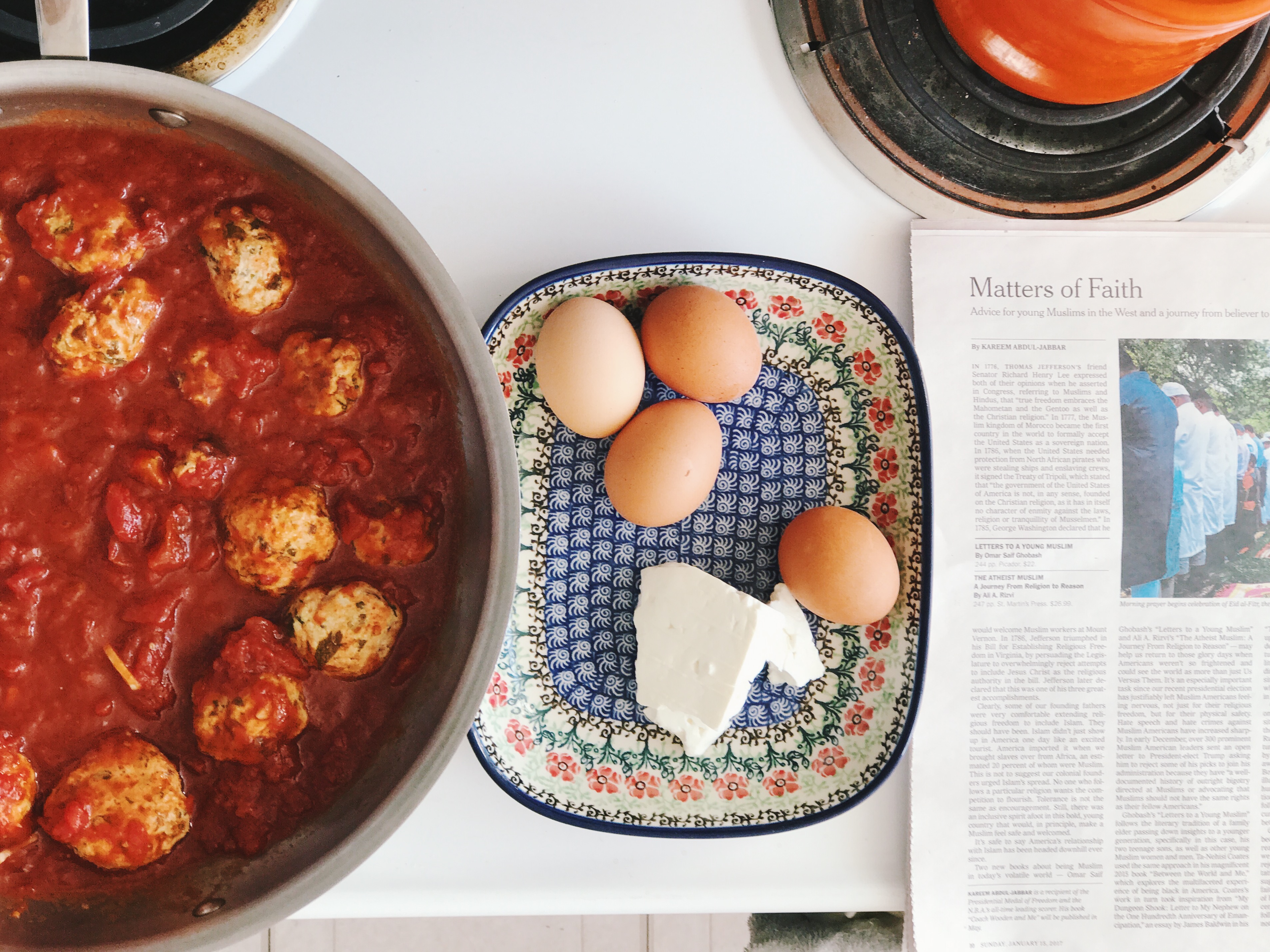
The photo above is from when I made her turkey and ricotta meatballs along with her very easy to doctor-up can-of-tomato sauce. The next morning I turned the leftovers into shakshuka, where you poach eggs in the simmering sauce (takes about ten minutes, just dump them in and put a lid on the pan) and then serve with a crumble of goat cheese.
-
secret peek at your neighbor-human





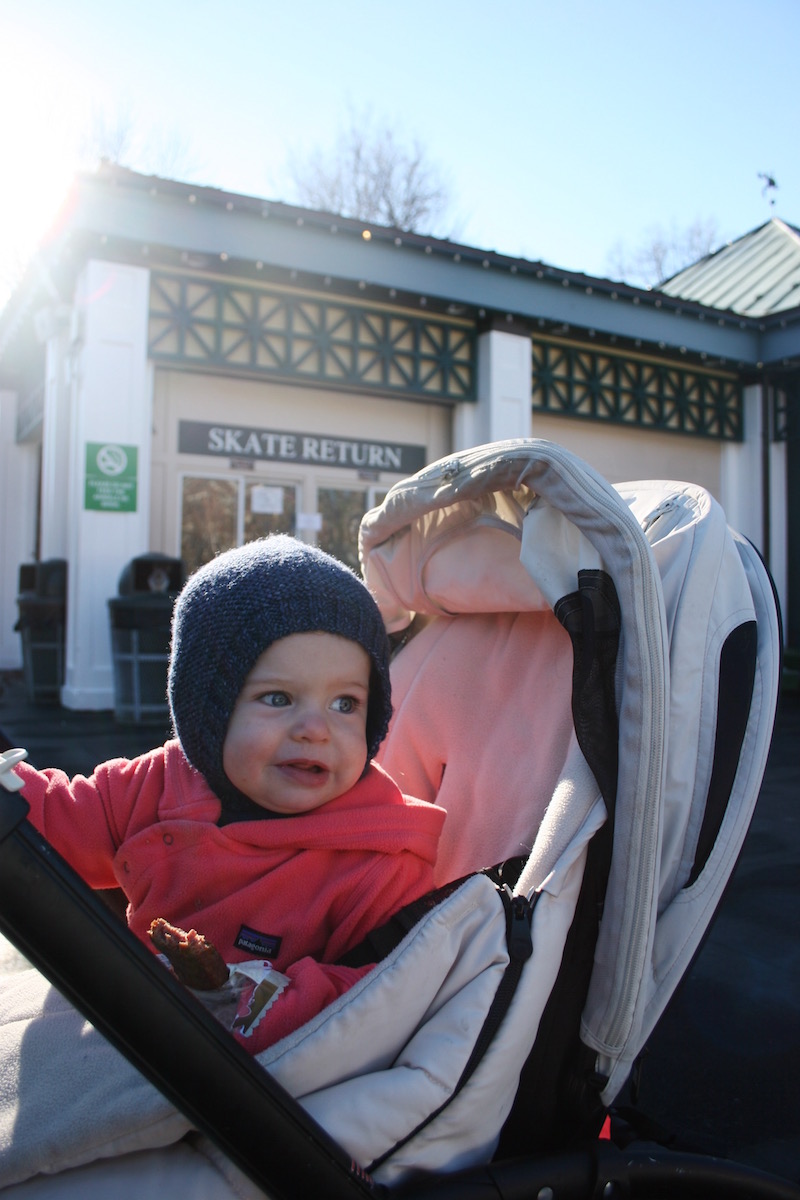




Even if you skate alone ice skating is romantic because it is a valentine to winter. People leave their cozy couches and make their way in the cold to a clear patch of blue ice. Then they lean down and yank-yank on their skate laces, totter like penguins over rubber mats, and finally step with their steel spindles onto the frozen water.
A few sail away like pretty ships, but many, many, slip and slide, fail, flail and laugh. Get back up, grab their friend’s hand, do it again. Laugh at themselves, lunge into the wall, gently push off, start over. Adults do this! They pay to do it! Sure, some of them are high on drugs, or optimism, or both. But they do it and it’s inspiring to see.
Sometimes you see someone walk out, just a guy, dressed in sweats. Maybe he’s slouching. His hat is covering his eyes. He walks to the ice and all of sudden it’s like he’s dancing. You can’t help but watch his ankles because they are like two birds weaving through the trees. He’s so good! Did he play hockey? Did his mom used to take him skating as a kid? Does he love to skate by himself on Tuesday afternoons every week? We’ll never know. Without them saying a word, you get a secret peek into your neighbor-human and you see how talented and graceful they are, and you just admire them so much, these strangers.
-
January 1, ladders and roe
 Coming back to our 700sq feet home as a family of five after an expansive sunny vacation is like parachuting into a gray November day from a bright one in June. You’re happy to have your feet back on the ground, it feels familiar and cozy and yet…crowded. Certainly there is too much stuff, and look: we’ve brought more back with us! Why are the book shelves already full? one wonders with a stack of new books in-hand.
 It’s a puzzle to find a spot for everything, and the trick is to take pleasure in the solving of it.
Over Christmas, my sister-in-law Hannah got me into this book Super Nutrition for Babies. I’m really grateful because reading it has been a wake up call for habits in our house. I find that you begin parenting saying to yourself my children will never order off a kid’s menu, or I’ll never buy kraft mac & cheese by the dozen and then things just happen. It starts to feel normal to have bags of animal crackers, pretzels, bread, and frozen waffles filling half your cart, or you get demoralized when they don’t fall in love with your roasted root veggies with horseradish on first kiss.
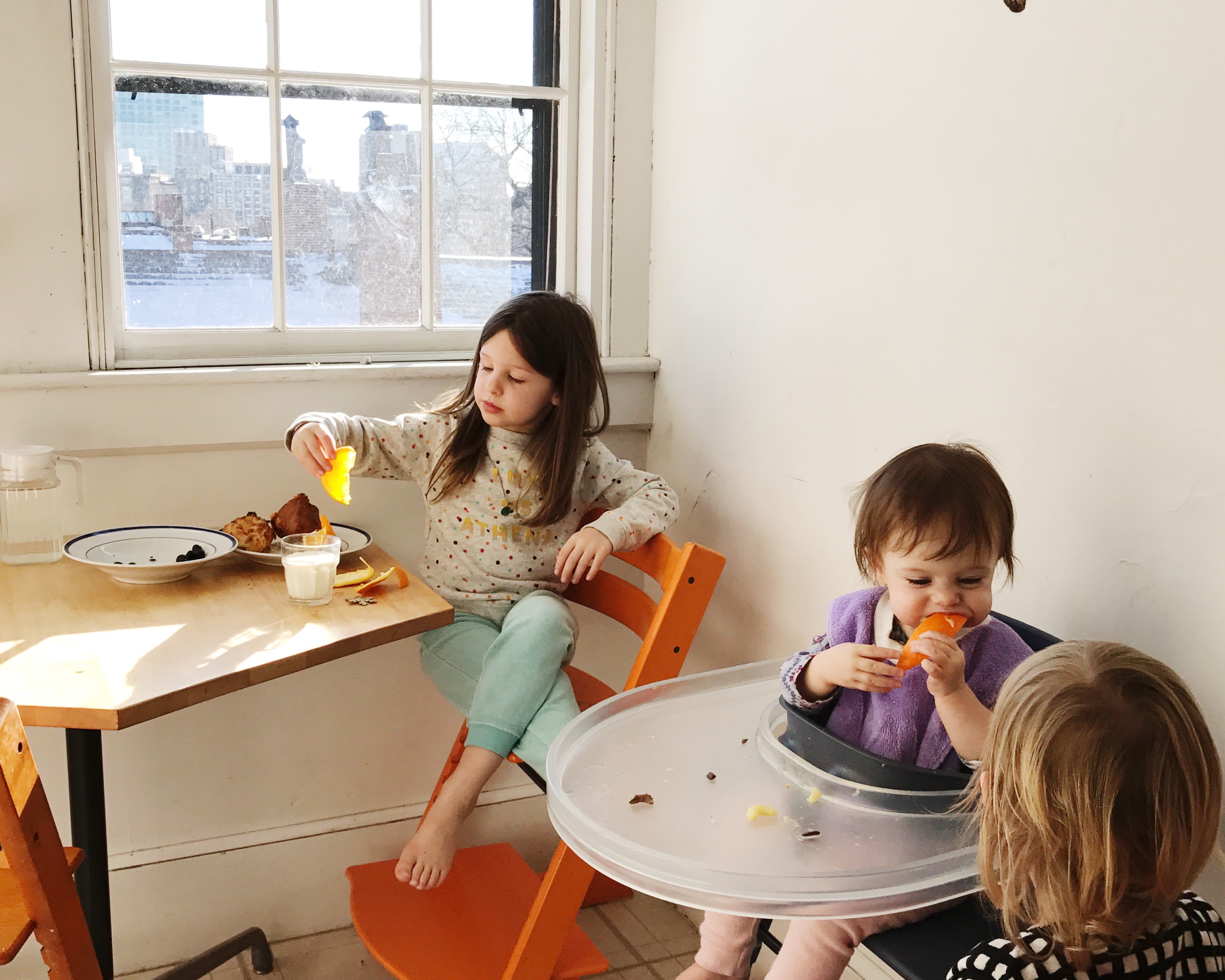
In particular, I was often offering Alma the same easy finger food as Joan: tossing pasta and fruit on her tray while I prepared a vegetable, only to find her full once I offered it.
So, after highlighting half the book on my kindle, I plowed into this week in full pursuit of a protein diet for the whole family, slipping lots of hard boiled eggs in (“here, eat this egg while I make you a sandwich”), keeping a steady supply of baked sweet potatoes in the fridge, and offering cheese or cold chicken for snacks. I made my first very tiny batch of bone broth. I poked around our seafood section for salmon roe for Alma, and I realized they sell white anchovies, a very mild and tasty fish, preserved in oil and vinegar, that all three girls love. I had never noticed it! I pestered our butcher counter and learned they tuck (incredibly cheap) frozen lamb liver and heart in nearly hidden spot in the freezer aisle.
I’m very glad to be shifting habits around in the pantry and refrigerator. These types of things are always followed by a briefly higher grocery bill, packing the wrong snacks, and lots more mental work. I’m trying to take it slowly and not be disappointed when change doesn’t come about with brilliant success. For instance, several times this week Lux ate nothing out of her lunch but the raw veggies I sent–all of the proteins (chopped chicken, container of yogurt) didn’t appeal to her by the lunch hour.
Upon reflection, nourishing this family is probably THE hardest job I do. I’m often amazed at how much time it takes to plan, prep, feed, and clean up. Other times I realize how important it is, and try to take up my pantrykeeper mantle boldly.
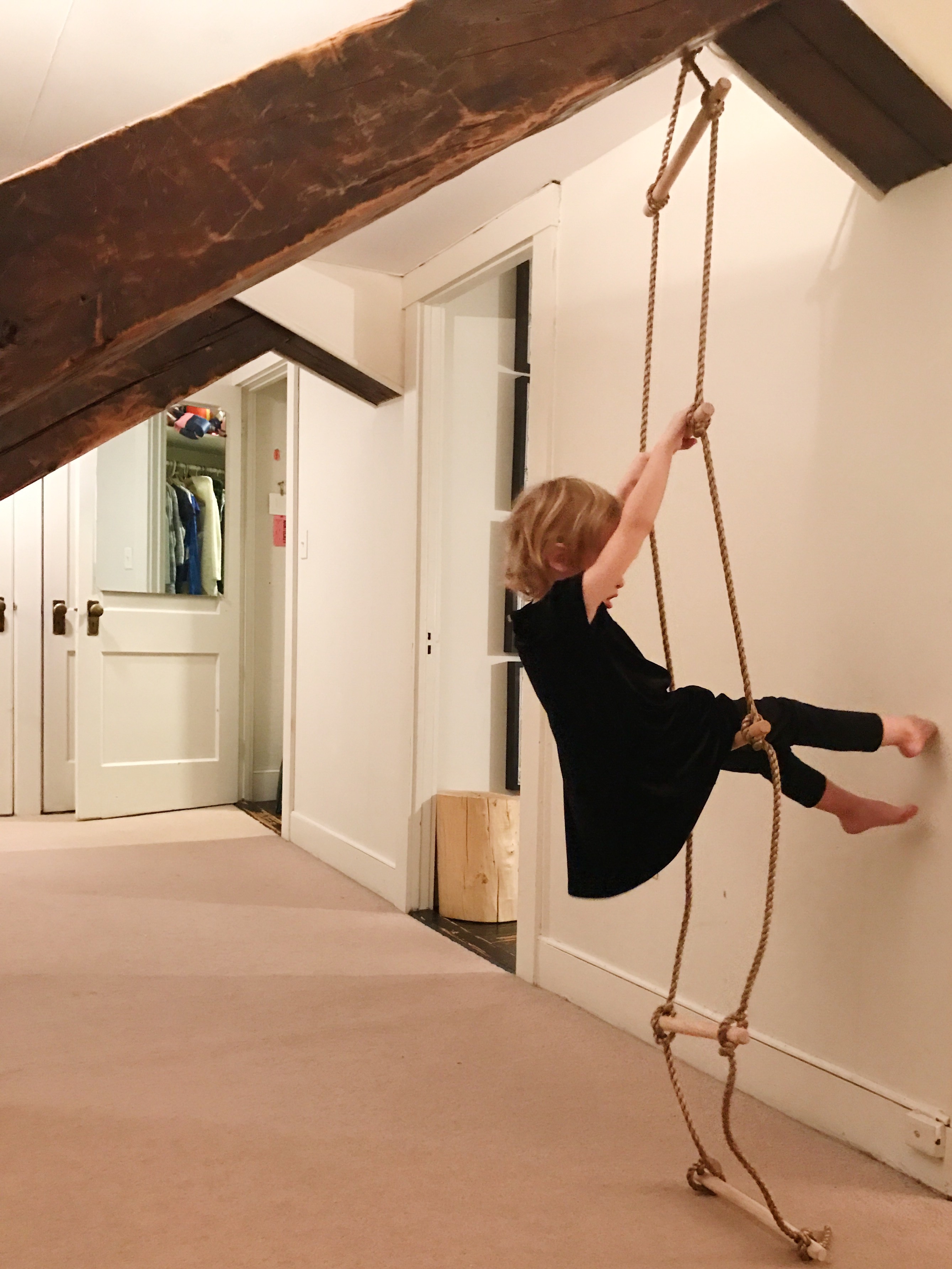
A rope ladder for Christmas, technically for Joan, but enjoyed by all three girls. Most of Joan’s play is imagination-based, she could pack a covered wagon full of salvaged post-it notes and beaded necklaces before you could say “cholera”, so it’s nice to have simple (mess-free) toys that facilitate her adventures as well.
-
a book in context
I started the The Good Earth, published 1931 by Pearl S. Buck, mid-December in the two weeks after Joe’s brother died; wretched strange weeks when the girls and I were sick with one morphing virus, a flu-cold, flights were delayed, our planes home sat on the tarmac then skid into airports hours late, we seemed to tuck them into bed, fall asleep listening to them cough, and then drag them out again before the sun even bothered to wink awake.
At the memorial service for their uncle the girls crumpled with me in a back row in grumpy feverish moods, wiping their snotty noses over and over, hiding their flushed faces in their elbows as old friends of the family stopped to say hello. The service was beautiful but our children weren’t, a fact that both prickled our pride and seemed fitting. One family member dead and well remembered, the rest alive and hard to look at. Each morning I woke up expecting our hack-coughs to be emptied overnight, no. Meanwhile our hero Wang Lung gratefully accepted his morning bowl of hot water, in bed, served by his new wife just after she carefully stoked the fire and served another bowl to his father.
Naturally there was no mention of Christmas on the pages of The Good Earth–though there is occasionally a fearful and fitful devotion to various gods, grabbing an incense stick when things seemed worrisome, cursing them loudly when things fell apart. Wang Lung’s marriage to O-lan is pragmatic, met with unexpected kismet and peace, yet there is still the unerasable impact of O-lan’s deprived childhood–the details of which are eluded to only vaguely. Wang Lung made no move, ever, to fix or soothe what had happened to her. Meanwhile I chased the girls with ointments of various types, devoting fifteen minutes to cajoling a smear on their red skin that was raw from their furtive side-wiping. The girls seemed to collectively give up eating, their proud young playground muscles almost immediately disappearing into knobby knees. At a certain point all three began to watch me as nothing but a kleenex threatening an attack on them. I fell into the role, really, it was almost impossible for me not track their snuffles and new symptoms with a graph chart.
Steadily I closed my senses to the american christmas hoopla around us that did not frame our Christmas this year at all. The sweet heaven-bound songs of the memorial service rang instead of carols, toast and soup replaced hot cocoa, sleeping late and watching movies, often oblivious to the accomplishment of festive traditions around us. Joe and I mostly looked at the girls, but when we managed to look at each other it was difficult to avoid the topic of missing Ross or preemptively imagining how sad this or that were going to be without Ross. Steadily Wang Lung remained devoted to his land, wholly disinterested in political events in his country and often oblivious to anything beyond the demands of his social structure. The narrative pours out like hot tea, the irony-free meditations faintly fragrant and soothing. Pearl Buck was the child of American missionaries, she held the duality of American and Chinese worlds in her mind, but she loved the Chinese one most, I think. Her flattering sketch of the countryside, the affectionate description of the “loaf of bread wrapped around a stick of garlic,” the laboring, planting, harvesting, well-earned resting that framed Wang Lung’s noble year. The pre-revolution farmer peasant world was harsh indeed, but you can tell she loved it. The GOOD earth.